Post Hole Drillingin East Texas
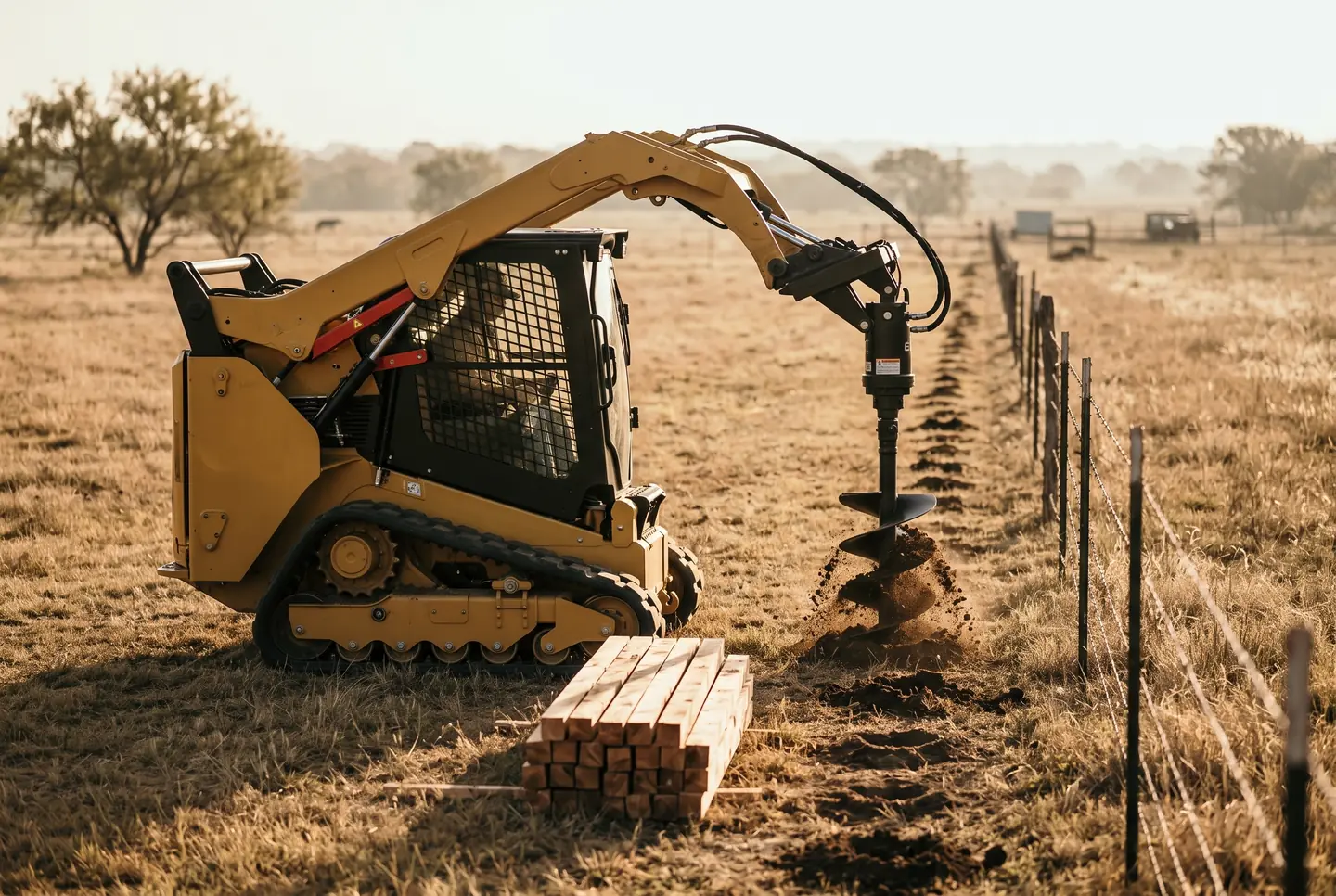
Post hole drilling in East Texas comes down to three things: the right bit, the right depth, and holes that line up. We run a hydraulic auger off a compact track loader with a set of interchangeable bits, so a fence line, a deck footing, and a pole barn each get the diameter they call for.
More than fence posts
Most of our post hole drilling is fence and gate posts, but the auger does not care what goes in the hole. We drill for deck and dock footings, pole barn columns, sign posts, flag poles, and tree planting. If it needs a clean vertical hole at a set depth, it is our kind of work.
- Fence lines and gate posts, corner and brace assemblies
- Deck, porch, and dock footings
- Pole barns and metal building columns
- Sign posts, entry columns, and flag poles
- Tree and shrub planting on acreage
Bits and diameters
Diameter follows the job. A T-post pilot is one thing and a pole barn footing is another, so we run interchangeable bits and pick the one that fits what you are setting. If you know your post size or the footing you need, tell us and we will match it. If you do not, describe the job and we will bring the right bit.
Depth is set the same way. Fence posts want a third of the post in the ground as a rule of thumb, footings follow the plan, and frost is not much of a factor in East Texas. Give us the number you need and the auger goes to it.
What East Texas ground does to an auger
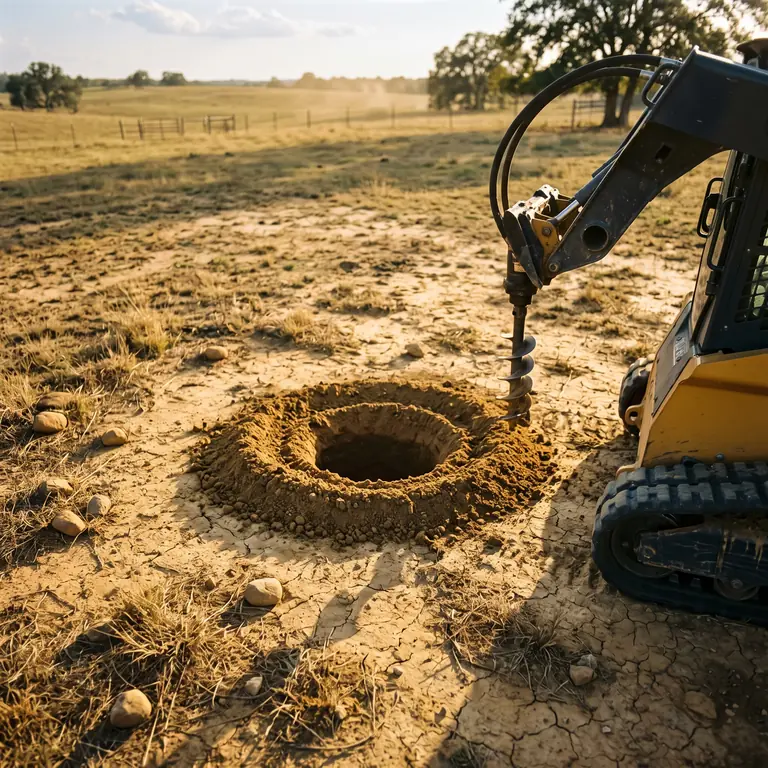
Around here the auger sees clay, sand, loam, and moderately rocky ground, sometimes all four on the same property. Sand drills fast and clean. Loam is easy. Clay is the one that fights you. Wet clay packs onto the flighting and rides up out of the hole instead of clearing, so it drills slower and the spoil comes out in heavy chunks. Dry clay can set up hard. We read it as we go and adjust speed and down pressure to keep the hole clean and round.
Rock is the honest limit. Moderately rocky ground is normal work and the auger pulls through it. Solid rock, a buried ledge, or an old slab is where any auger slows down or stops. If we hit that, we tell you what we are seeing and talk through options instead of grinding on it and running your bill up.
How many holes fit in a day
More than people expect, and it depends on four things: diameter, depth, soil, and spacing. A run of standard fence holes in good ground moves quick, because the bit is small and the machine tracks right down the line to the next one. Deep, wide footings in clay take longer per hole. The honest answer is that a normal residential or ranch fence line is usually a single visit, and we will give you a real day count once we know the count, size, and ground.
Other work we do
Trenching
Water, electric, fiber, irrigation, French drains, gas. Narrow, straight, at the depth you set.
Read moreGrading & Leveling
Building pads, low spot fills, drainage grade, arena and pen leveling.
Read moreGravel Driveways
New drives, regrading, washout and pothole repair, crowning for drainage.
Read moreTell us about the job.
Send the details and we will get you a straight quote. Post holes, a trench, a pad, a driveway, or all of it in one trip.